Who am I?
RPPS Number : 10000529403
GLN Login : 7601000883728
RCC Number : L 2801.25
Ready to book an appointment?
Areas of expertise
Throughout my training (link to detailed CV) and my career, I have performed a wide range of procedures, from minor conditions such as ingrown toenails to major craniofacial malformations.
My expertise has progressively developed thanks to my patients’ trust and the continuous advancement of medical techniques. Today, I primarily focus on:
- Facial surgery (rejuvenation procedures, prominent ear correction, rhinoplasty)
- Breast and abdominal surgery (using only the most up-to-date techniques)
- Skin cancer surgery
My specialities
- Post-graduate FMH specialist in plastic, reconstructive, and cosmetic surgery.
- MActive member of the International Society of Aesthetic and Plastic Surgery (I.S.A.P.S.) (International Society of Aesthetic and Plastic Surgery). www.isaps.org
- Active member of the Swiss Society of Plastic, Reconstructive, and Cosmetic Surgery SWISS PLASTIC SURGERY
- Active member of the American Society of Plastic Surgery : ASPS
- Head of the History Section of the SOFCPRE. www.plasticiens.org
- Active member of the French Society of Plastic, Reconstructive, and Cosmetic Surgery SOFCPRE.
- Active member of the Association of Medical Doctors of Geneva AMG
- Active member of the Waldensian Society of Medical Doctors SVM
- Secretary-General of the French Society of Plastic Surgeons SOFCEP SOFCEP (2005-2007).
- Instructor at Cochin-Tarnier hospital (Paris;1998-2008).
- Instructor at Pitié-Salpêtrière hospital (Paris 1993-1998)
- Former resident intern at Paris Hospitals ( AIHP- Hôpital St Louis, Hôpital Saint-Antoine, Hôpital Necker-Enfants-Malades)
- Former Assistant Clinical Head of Paris Hospitals (ACCA-Pitié-Salpêtrière Hospital).
- Swiss Federation of Medical Doctors (FMH N° 023254 – 56 03 / 93), www.fmh.ch
- Association of Medical Doctors of the canton of Geneva (AMG) www.amge.ch
- Waldensian Society of Medical Doctors (SVM) www.svmed.ch
Dr. Marianne Prevot is distinguished by numerous international scientific publications. She therefore contributes, with her colleagues from Switzerland and around the world, to the excellence of international plastic surgery.
Make an appointement
If you wish to benefit from a personalised consultation with Dr Marianne Prevot.

Scientific activities
Within the SOFCPRE :
Secretary of the History Chapter. Organization of Round Tables at the National Annual Congress.
2018 : History of breasts. History of mastectomy; the beginnings of breast reconstruction; controversies surrounding the use of silicone in the USA and Europe in the 1990s: what can we conclude 28 years later?; History of breast reduction surgery; Léon Pérèl (1910–1986) and breast reconstruction.
2019 : Transplantation throughout History. Organ transplantation and plastic surgery; Joseph Murray (1919–2012), plastic surgeon and Nobel Prize laureate; Hippolyte Morestin and fat grafting; History of cartilage grafts.
Author of the Master’s thesis in Philosophy (Ethires): “The Mission of Plastic Surgery”
Annual Report of Reconstructive and Aesthetic Plastic Surgery 2018 : Forehead aging: analysis and treatments. Elsevier.
Personal Work : Scientific presentations and publications
SOFCPRE 2015
Indications and contraindications of breast implants in the treatment of breast ptosis.
SFME 2012 (French Society of Aesthetic Medicine)
How to choose botulinum toxin? M. Prevot, MD.
ISAPS 2011
How to Ensure Final Breast Volume in Augmentation Mammaplasty. M. Prevot, MD.
Criteria for aging lips in women: a review of 100 cases aged 47 to 80. M. Prevot, MD.
SOFCPRE 2011
Criteria for lip aging in women: analysis of 100 women aged 40 to 80.
SOFCPRE 2010
Surgical treatment of complications related to aesthetic procedures. Marianne Prevot; Jacques Buis; Henry Delmar; Laurent Lantieri.
VIDEOFORUM TOULOUSE – SOFCPRE 2009
Complications of aesthetic body contouring surgery : liposuction and abdominoplasty. Literature review. M. Prevot, MD.
Dr Prevot’s Philosophy
“The pursuit of harmony, visual pleasure, and the emotion of calm fulfillment characterizes humanity and is reflected in the aesthetic quest of all reconstructive surgery. For Kant (Critique of Judgment, 1790), the aesthetic experience is a universal emotion : ‘That which pleases universally without concept is beautiful.’”
DR marianne prevot
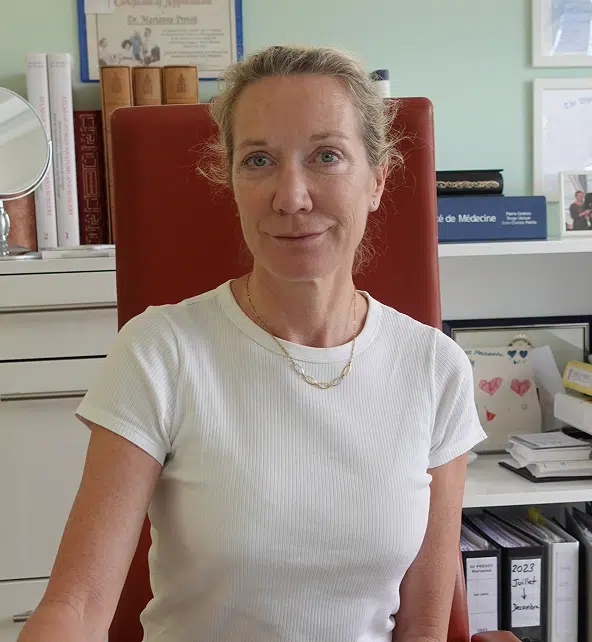
Dr Marianne prevot is a plastic surgeon in Geneva specializing in aesthetic reconstructive pediatric and dermatologic surgery. With more than 20 years of experience she combines medical expertise scientific commitment and a human centered approach.
Her practice is based on harmony between body and mind with an ethical and balanced vision of surgery.